
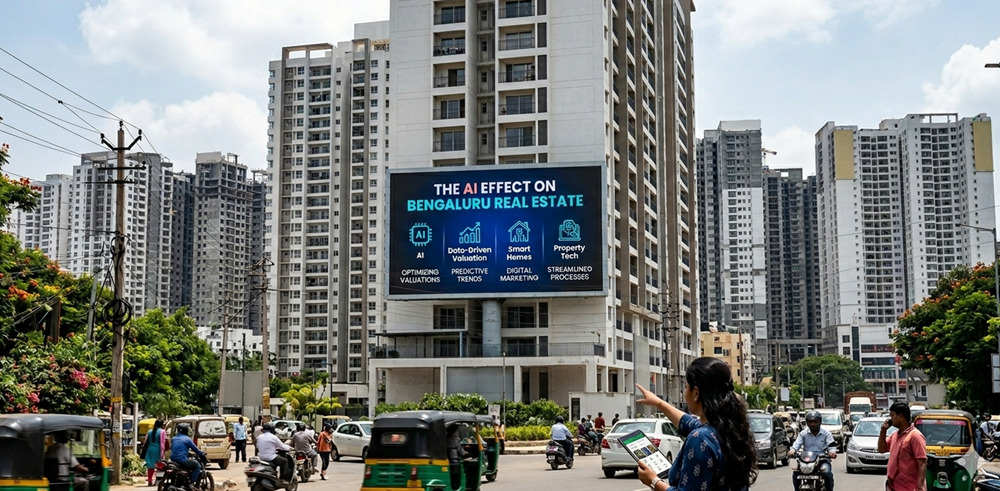
The AI impact on Bangalore real estate is likely to become one of the most important themes shaping the city’s property market over the next decade. Bangalore already stands at the center of India’s technology economy, with a deep talent pool, strong startup ecosystem, growing GCC presence, and a concentration of product, cloud, data, and R&D teams. As artificial intelligence becomes more deeply woven into business growth, the city could see fresh waves of high-value employment, stronger commercial activity, and rising demand for housing in the right locations.
But AI will not influence every part of Bangalore equally.
Real estate growth usually follows a simple pattern: jobs create demand, infrastructure supports mobility, and liveability sustains value. That is why the future of Bangalore real estate will likely be shaped less by citywide hype and more by a handful of corridors where employment access, transit improvements, and residential quality come together.
For investors, NRIs, homebuyers, and working professionals, the practical question is clear: which areas in Bangalore are best positioned to benefit from AI-led growth by 2035? This article looks at that question through a neutral, market-led lens, while also highlighting selected project-level opportunities that align with those broader corridor trends.
What AI Could Mean for Bangalore Real Estate
Artificial intelligence will not directly raise property prices. Its real effect will come through the economic and lifestyle shifts it creates.
1. AI-led job growth could support housing demand
As AI expands across software, enterprise platforms, analytics, automation, cloud infrastructure, and cybersecurity, Bangalore may continue attracting highly skilled professionals. This often supports residential demand in well-connected neighbourhoods close to business districts.
2. Office demand may evolve, not disappear
AI may change how companies use office space, but it is unlikely to remove Bangalore’s importance as a workplace city. High-quality office hubs are still likely to matter, and nearby housing markets may continue to benefit.
3. Buyer preferences may become more selective
By 2035, more buyers may prioritize the following:
- work-from-home flexibility
- better community infrastructure
- shorter commute options
- long-term livability
- access to schools, retail, and healthcare
4. Infrastructure-backed corridors may gain more
Areas with metro links, airport access, strong road networks, and proximity to employment hubs are more likely to benefit than speculative pockets with weak execution.
Key takeaway: The AI impact on Bangalore real estate is likely to be strongest where jobs, infrastructure, and liveability already align.
Why Bangalore Is Well Positioned for AI-Led Growth
When people ask about the future of Bangalore real estate, the answer often comes back to the city’s structural strengths.
Why Bangalore stands out
- deep engineering and digital talent base
- strong startup and innovation culture
- expanding GCC and enterprise technology footprint
- multiple office clusters across the city
- continued metro, road, and airport-led infrastructure growth
- strong demand from both domestic and NRI buyers
Bangalore’s advantage is that it already has a mature technology economy. That means AI is more likely to amplify existing real estate demand rather than create a new market from nothing.Summary: Bangalore is better placed than most Indian cities to convert AI-led economic growth into real residential and commercial demand.

How AI May Change Buyer and Investor Preferences
AI-driven growth may not only affect where jobs are created. It may also change what people value in a property.
Likely trends by 2035
- stronger demand for homes with study or flexible-use spaces
- more interest in planned communities over isolated buildings
- higher value placed on mobility and reduced commute friction
- more preference for better-maintained, future-ready developments
- growing focus on rental resilience and tenant quality
For investors, this means project quality and neighbourhood utility may matter even more than a “hot” location label.
Summary: In the AI era, the market may increasingly reward useful, well-connected, liveable homes, not just heavily marketed addresses.
Best Investment Corridors in Bangalore to Watch by 2035
1. Whitefield
Whitefield remains one of Bangalore’s strongest long-term real estate corridors. It combines office depth, metro support, social infrastructure, and a mature residential market.
Why Whitefield stands out
- established technology and business ecosystem
- strong rental market
- metro-backed accessibility
- proven end-user demand
AI outlook
If AI growth continues through enterprise technology, product companies, and GCC expansion, Whitefield is likely to remain one of the city’s most resilient and stable housing markets.
Best for: Stable investors, NRIs, professionals, end-users
2. Sarjapur Road
Sarjapur Road continues to stand out because of its access to multiple job hubs including ORR, Whitefield, and Electronic City.
Why Sarjapur Road stands out
- multi-hub connectivity
- steady family and professional demand
- growing social infrastructure
- balanced mix of mid-segment and premium housing
AI outlook
In a more distributed work environment, corridors that connect to several office clusters may become even more valuable.
Soft project context: Buyers exploring Sarjapur Road often compare integrated communities with strong livability credentials. In that context, Assetz 63 Degree East is one of the projects that naturally fits the corridor’s long-term end-user and investment narrative.Best for: Long-term investors, families, professionals
3. North Bangalore (Hebbal and Devanahalli)
North Bangalore remains one of the city’s most important long-horizon growth stories.
Why North Bangalore stands out
- airport connectivity
- commercial and institutional expansion
- premium gateway role in Hebbal
- large-format growth potential in outer belts
AI outlook
If Bangalore continues to attract more global operations, research-led teams, and business travel-driven expansion, North Bangalore could become even more relevant.
Soft project context: In the broader North Bangalore discussion, Assetz Palmscape on IVC Road fits the profile of a project that may appeal to buyers looking at longer-term appreciation linked to the airport-region story.Best for: Long-term investors, NRI buyers, plotted development seekers
4. Outer Ring Road Influence Zones
The ORR belt remains central to Bangalore’s office economy. Nearby residential catchments continue to matter for professionals who want access to core business districts without necessarily buying at the most premium office-facing price points.
Why these zones stand out
- close to major job nodes
- durable rental demand
- strong utility for working professionals
- long-term relevance tied to business density
AI outlook
As AI-led teams grow within enterprise and software businesses, ORR-linked residential markets may continue to see strong tenant and buyer interest.Best for: Rental investors, professionals, urban buyers
5. Thanisandra Road and Hennur Road
These corridors have become mainstream investment choices because they combine access to employment hubs with relatively more practical entry pricing.
Why they stand out
- access to major office zones
- growing residential demand
- strong rental potential
- improving long-term livability
AI outlook
These locations may benefit from broad-based workforce housing demand rather than only premium-end housing demand, making them useful for investors focused on occupancy and medium-term appreciation.Best for: Rental-focused investors, professionals, mid-segment buyers
6. Electronic City
Electronic City remains one of Bangalore’s most practical job-led property markets.
Why it stands out
- established office ecosystem
- relatively accessible pricing
- strong tenant base
- long-term relevance through employment demand
AI outlook
Electronic City may continue to benefit from the broader technology economy, even if some of the premium AI-driven demand concentrates elsewhere.Best for: First-time investors, value-focused buyers, rental investors
7. Kanakapura Road
Kanakapura Road offers a more residential, end-user-led growth story backed by metro connectivity and long-term livability.
Why it stands out
- metro access
- family-oriented demand
- calmer living environment
- good long-term residential appeal
AI outlook
As work patterns evolve, corridors offering quality of life alongside access may become more attractive to professionals and families.
Soft project context: Within this corridor, Assetz Meru And Meadow can be viewed as a project that aligns with Kanakapura’s long-term residential and lifestyle-led demand story.Best for: Families, end-users, long-term investors
8. East Bangalore Expansion Belt
Beyond the better-known East Bangalore markets, emerging corridors in the broader expansion belt may offer longer-term opportunities for early-stage buyers.
Why it stands out
- spillover from established East Bangalore hubs
- room for longer-term growth
- lower entry points in select pockets
- future infrastructure-driven upside
AI outlook
Not every emerging eastern pocket will succeed, but some may benefit as demand moves outward from mature East Bangalore locations.
Soft project context: Assetz Codename Sublime in Hoskote, East Bangalore fits this early-entry theme for buyers who are comfortable with a longer holding period and gradual corridor evolution.Best for: Early-stage investors, long-horizon buyers
Project-Level Opportunities in Bangalore’s AI-Linked Growth Corridors
| Project Name | Area | Investment View | Best For |
| Assetz 63 Degree East | Sarjapur Road, Bangalore | Strong long-term potential due to access to major tech corridors and sustained end-user demand | End-users, long-term investors |
| Assetz Codename Sublime | Hoskote, East Bangalore | Emerging growth bet tied to East Bangalore expansion and future infrastructure spillover | Early-stage investors, long-horizon buyers |
| Assetz Palmscape | IVC Road | Positioned for long-term appreciation linked to North Bangalore and airport-region growth | Land-focused investors, long-term buyers |
| Assetz Meru And Meadow | Kanakapura | Supported by metro-led residential demand and improving South Bangalore connectivity | Families, end-users, long-term investors |
2015 vs 2025 vs 2035: How Key Corridors May Evolve in the AI Era
This table presents a directional market view, not a guarantee of future returns.
| Corridor | 2015 Market Position | 2025 Market Position | 2035 AI-Era Outlook | Likely Growth Drivers |
| Whitefield | Established IT hub | Mature metro-backed tech market | Strong and stable | AI-linked office expansion, metro access, premium housing demand |
| Sarjapur Road | Fast-growing residential stretch | Major multi-hub housing corridor | Strong | Connectivity to multiple job hubs, family demand, talent housing |
| Hebbal | Premium gateway location | Strategic North Bangalore node | Very strong | Airport access, GCC growth, commercial expansion |
| Devanahalli | Early-stage outer market | Airport-led long-term growth zone | High upside, slower timeline | Airport ecosystem, logistics, large-format development |
| Thanisandra Road | Emerging affordable corridor | Active rental-led market | Strong | Workforce housing, Manyata influence, urban densification |
| Hennur Road | Developing residential pocket | Rising upper mid-segment corridor | Strong | North-East connectivity, talent-driven housing demand |
| Electronic City | Established job-led market | Affordable tech corridor | Moderate to strong | Employment base, infrastructure upgrades, rental resilience |
| ORR Influence Zones | Premium job-linked catchment | High-demand housing ecosystem | Strong and durable | Office depth, commute advantage, rental demand |
| Yelahanka | Planned residential suburb | North Bangalore support market | Strong long term | Livability, airport-region spillover, family housing demand |
| Kanakapura Road | Metro-led emerging corridor | Strong residential destination | Moderate to strong | Livability, metro access, end-user demand |
Key takeaway: AI is more likely to accelerate existing strengths than create entirely new winners.
Risks Investors Should Not Ignore
1. AI can become a buzzword
Some locations may use the AI narrative without having real economic support or infrastructure depth.
2. Overbuilding remains a risk
If project supply rises much faster than actual demand, rental growth and appreciation may slow.
3. Infrastructure delays still matter
Announcements are useful, but delivered infrastructure usually matters far more to long-term returns.
4. Premium pricing has limits
Even good corridors can underperform if projects are priced beyond end-user absorption levels.Summary: AI can be a growth catalyst, but it does not replace pricing discipline, location research, or project-level due diligence.
What Buyers and Investors Should Look For Between 2026 and 2035
If you are evaluating Bangalore property for the next cycle, focus on these filters:
- proximity to real employment hubs
- metro, airport, or arterial road access
- rental demand depth
- long-term livability
- community design and maintenance quality
- realistic pricing
- credible developer execution
- fit with your personal holding horizon
This applies whether you are buying for self-use, rental income, or capital appreciation.
Conclusion
The AI impact on Bangalore real estate is likely to be meaningful, but selective. AI will not transform every micro-market equally. Instead, it may strengthen demand in corridors that already combine employment access, infrastructure delivery, and long-term livability.
That is why locations such as Whitefield, Sarjapur Road, Hebbal, Devanahalli, Thanisandra, Hennur, Electronic City, and Kanakapura Road deserve close attention through 2035.
These corridors are better positioned to benefit if AI-led economic growth translates into higher incomes, stronger office demand, and more selective housing preferences. For readers exploring project-level opportunities, select developments in these corridors can also be assessed through the same lens: connectivity, demand depth, holding horizon, and long-term relevance.
In the AI era, the smartest Bangalore real estate decisions will still come from following fundamentals, not just buzzwords.