
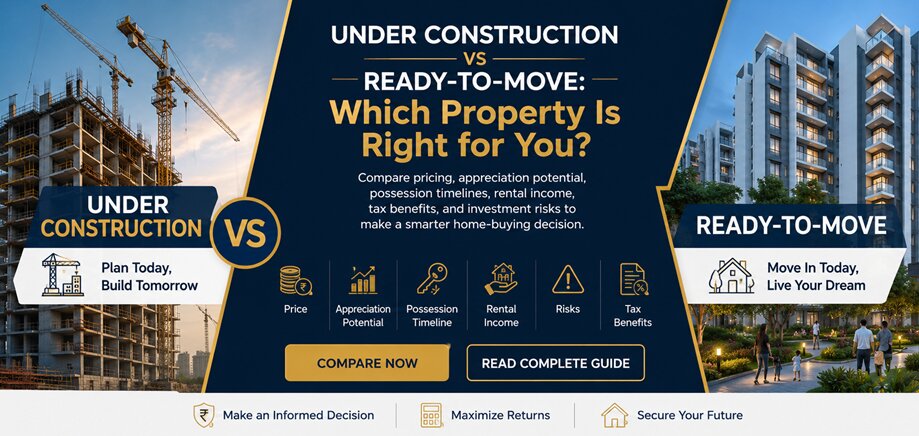
The question of under construction vs ready-to-move has become one of the most practical decisions in Bangalore real estate. Buyers are no longer asking only where to buy. They are also asking what stage of property is smarter to buy.
That matters because the answer can change both return and risk.
In a city like Bangalore, where property prices have moved up in multiple corridors and new supply continues to enter the market, the choice between an under-construction home and a ready-to-move property is no longer just about convenience. It is about how you want to balance entry price, appreciation potential, rental income, possession certainty, and overall ROI.
For some buyers, under-construction property looks attractive because the entry price is lower and the upside can be better if the project is bought early and delivered well. For others, ready-to-move feels more practical because the asset is visible, usable, and can start generating rental income immediately. Both choices can make sense — but not for the same buyer.
Quick Answer
If your goal is higher appreciation potential and you are comfortable with waiting and execution risk, under-construction property may offer better ROI.
If your goal is lower uncertainty, immediate possession, and rental income, ready-to-move property may offer better practical returns.
In simple terms:
- Under-construction is often stronger for upside
- Ready-to-move is often stronger for certainty
- The better ROI depends on your timeline, risk tolerance, and purpose of purchase
Why buyers are attracted to under-construction homes
There are a few reasons this category continues to appeal to Bangalore buyers:
- lower entry pricing in earlier phases
- staggered payment schedules
- possibility of appreciation before possession
- access to newer inventory in growing corridors
- more choices in layout, tower, or view in some projects
For many investors, this is the key attraction. Buying earlier in the cycle can sometimes create better upside by the time the project is ready.
But there is a trade-off
Under-construction buying also comes with:
- waiting time
- execution risk
- delayed rental income
- uncertainty around final delivery timelines
- dependence on builder credibility
So, while the upside may look attractive, the return is not always automatic.
Key takeaway: Under-construction property is often a higher-upside, higher-uncertainty option.
What Does Ready-to-Move Property Mean?
A ready-to-move property is one that is completed and available for immediate possession.
Why buyers prefer ready-to-move
Ready-to-move homes appeal to people who want:
- immediate clarity
- no construction-stage uncertainty
- actual possession now
- the ability to live in or rent the property immediately
- better visibility on what they are paying for
You are not buying a promise. You are buying a finished asset.
What makes this attractive
That matters especially for:
- end-users who need a home soon
- families who do not want to wait
- investors who want immediate rental income
- cautious buyers who prioritize certainty over future upside
But ready-to-move also has trade-offs
These properties often come with:
- higher ticket size than earlier-stage under-construction projects
- lower appreciation runway compared with early-phase buying
- limited choice if the project is already largely sold out
Key takeaway: Ready-to-move property is often a lower-uncertainty, lower-surprise option, but not always the cheapest entry point.
Under Construction vs Ready-to-Move: What Actually Affects ROI?
When people talk about ROI, they often think only about future resale value. But return in real estate is shaped by more than one factor.
In Bangalore, ROI usually depends on:
- entry price
- holding period
- appreciation potential
- rental income
- construction or possession risk
- location quality
- builder reliability
- opportunity cost of money
That is why the better choice is not always obvious.
A cheaper under-construction property can still deliver weaker ROI if:
- the project is delayed
- the location underperforms
- the builder loses market trust
Similarly, a ready-to-move property can still deliver strong ROI if:
- it starts earning rent immediately
- the corridor continues to appreciate
- the asset is in a strong end-user market
Bottom line: ROI is not only about buying lower. It is about buying correctly.
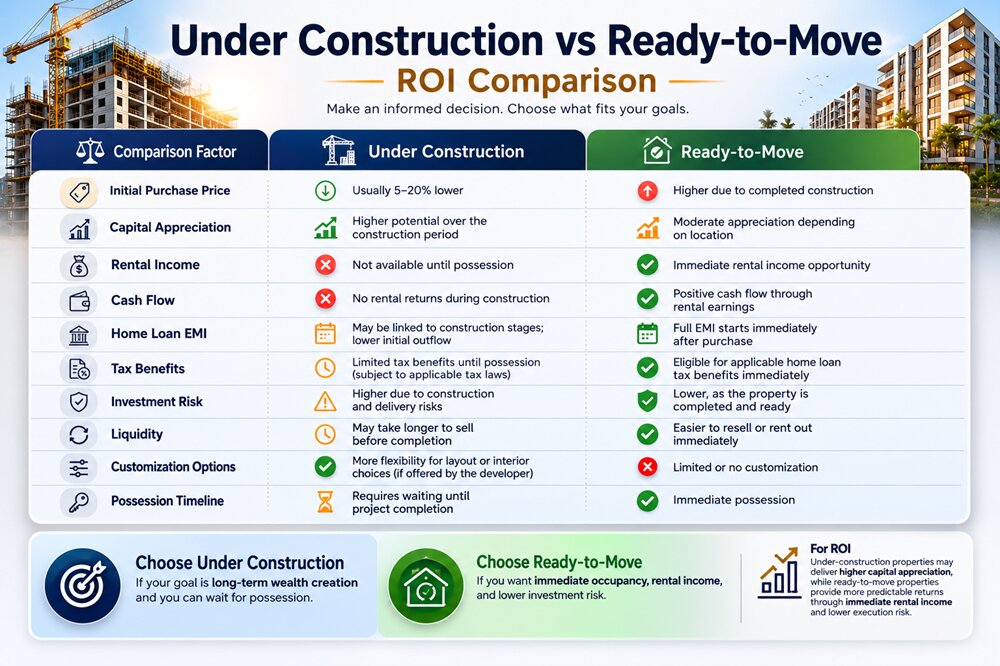
ROI Comparison Table: Under Construction vs Ready-to-Move
| Factor | Under Construction | Ready-to-Move |
| Entry price | Usually lower in earlier phases | Usually higher |
| Appreciation upside | Often higher if bought early | Usually more moderate |
| Rental income | Starts only after possession | Can start immediately |
| Possession certainty | Lower | Higher |
| Construction / delivery risk | Higher | Minimal |
| Payment structure | Staggered | Larger upfront commitment |
| End-user usability | Delayed | Immediate |
| ROI visibility | Future-led | More immediate and measurable |
This is why both categories remain attractive — just to different buyer types.
Which Is Better for Appreciation?
If your goal is capital appreciation, under-construction property often has the edge.
Why under-construction can outperform
When bought at the right stage, under-construction homes may benefit from:
- lower launch pricing
- pricing revisions during construction
- broader market movement during the build cycle
- corridor growth before possession
This is especially true in Bangalore when:
- the project is in a strong corridor
- infrastructure is improving
- the builder has a credible track record
- the market is in an active demand cycle
When the appreciation story weakens
The appreciation advantage may reduce if:
- the project is overpriced at launch
- delivery is delayed
- too much supply enters the same micro-market
- the location does not mature as expected
So yes, under-construction often offers better appreciation potential but not guaranteed appreciation.
Better for appreciation:
Under-construction, when chosen well
Which Is Better for Rental Income?
If your goal is rental yield or immediate cash flow, ready-to-move property is usually stronger.
Why ready-to-move wins here
A ready-to-move home can:
- start generating rent soon after purchase
- reduce the waiting period for income
- give investors faster clarity on occupancy and tenant demand
This is especially useful in Bangalore corridors with strong job demand such as:
- Whitefield
- Electronic City
- Sarjapur-linked zones
- mature East or South-East markets
Why this matters
A ready asset starts working earlier. That changes the financial equation, especially for investors who care about:
- monthly return
- reducing vacant holding time
- real rather than projected income
Better for rental income:
Ready-to-move
Which Is Better for Investors?
For investors, the answer depends on what kind of investor they are.
Under-construction may suit investors who
- want better entry pricing
- are comfortable with waiting
- can evaluate builder credibility well
- are targeting appreciation more than immediate rent
- have a medium- to long-term horizon
Ready-to-move may suit investors who
- want immediate rental income
- want lower risk
- prefer clearer asset visibility
- do not want to wait through construction cycles
- value capital preservation over aggressive upside chasing
Investor reality
Many investors assume under-construction automatically means better returns. That is not always true. The better choice depends on:
- how early you enter
- whether the project is sensibly priced
- whether the builder actually delivers on time
- whether the corridor has real demand support
Investor summary:
- Appreciation-seeking investor → under-construction
- Income-seeking / lower-risk investor → ready-to-move
Which Is Better for End-Users?
For end-users, the decision is often less about maximum ROI and more about timing and comfort.
Under-construction may suit end-users who
- are planning ahead
- are okay waiting
- want phased payments
- prefer entering a newer community at an earlier stage
- are buying in a project and builder they trust
Ready-to-move may suit end-users who
- need a home now
- want possession certainty
- do not want construction uncertainty
- are buying for family use
- want to see the finished product before deciding
What families often prefer
Families, especially those with school-going children or urgent housing needs, often lean toward ready-to-move because it offers more predictability.
End-user summary:
- Need now → ready-to-move
- Planning ahead and comfortable waiting → under-construction
Common Mistakes Buyers Make
1. Assuming lower entry price means better ROI
A lower price is useful only if the project and location actually perform.
2. Ignoring builder credibility
In under-construction buying, builder quality can matter as much as location.
3. Buying ready-to-move only because it feels safer
Safety matters, but buyers should still ask whether the price already includes most of the upside.
4. Comparing only EMI vs current rent
The decision is bigger than monthly outflow. You also need to compare:
- timing
- future appreciation
- rent potential
- certainty
- opportunity cost
Key takeaway: Wrong project selection can ruin both under-construction and ready-to-move ROI.
A Simple Buyer Checklist
Before deciding, ask:
- Am I buying for appreciation, rental income, or self-use?
- Can I wait for possession, or do I need the asset now?
- Is the builder reliable enough for under-construction risk?
- Does the ready-to-move property justify its price premium?
- Will this corridor still make sense 5 years from now?
That checklist is far more useful than a generic “buy now” mindset.
Final Verdict
So, under construction vs ready-to-move — which offers better ROI in Bangalore?
The honest answer is:
- Under-construction usually offers better upside potential
- Ready-to-move usually offers better certainty and immediate practical returns
If your goal is:
- capital appreciation → under-construction often has the advantage
- rental income and lower uncertainty → ready-to-move usually works better
- family use and immediate possession → ready-to-move is often the safer choice
- long-horizon investing with risk tolerance → under-construction can be more rewarding
There is no universal winner.
The better option depends on:
- your timeline
- your financial readiness
- your risk appetite
- your actual purpose for buying
In short, the best ROI in Bangalore does not come from choosing a stage blindly — it comes from choosing the right stage for the right asset in the right corridor.
FAQ:
Under-construction can offer stronger appreciation upside, while ready-to-move can offer better certainty and immediate rental income. The better ROI depends on the buyer’s goal.
Yes. Under-construction property usually carries more execution and delivery risk than ready-to-move property.
In many cases, yes. Ready-to-move properties are often priced higher because they offer immediate possession and lower uncertainty.
It depends on the buyer’s situation. Ready-to-move is better for those who want certainty and immediate use, while under-construction may work for buyers planning ahead with a longer timeline.
In Bangalore, under-construction may be better for appreciation-focused buyers, while ready-to-move may be better for buyers prioritizing rental income, certainty, or immediate end use.